
A homeowner in Leawood turns over a shovel of garden soil and finds what looks like a writhing, thrashing snake. The worm is smooth, glossy, and moves in a distinctive S-shape that ordinary earthworms cannot produce. Neighbors across the fence have been noticing similar worms, and the raised garden beds the homeowner installed two years ago now sit several inches lower than when they were built. Kansas City pest control companies fielding these calls, including ZipZap Termite & Pest Control in Lawson, have to deliver a message most homeowners have a hard time accepting: there is no legal pesticide treatment that works against Asian jumping worms, and any company claiming otherwise is either wrong or dishonest. The actual management approach is cultural and preventive, and understanding the biology explains why.
Identifying Asian Jumping Worms
Asian jumping worms are several species in the genus Amynthas, sometimes also Metaphire, introduced to North America from East Asia. They go by several names in public discussion: crazy worms, snake worms, Alabama jumpers, and jumping worms. All refer to the same basic group of species sharing distinctive biology and behavior.
Visual identification relies on several consistent features. The clitellum, the raised band near the head that distinguishes adult worms, is smooth, flat, and pale gray or cream colored, and it wraps completely around the body. Common European earthworms, by contrast, have a raised, saddle-shaped clitellum that does not fully encircle the body. Adult jumping worms reach 4 to 8 inches, sometimes longer, and their skin has a slightly iridescent, glossy appearance rather than the pinkish tone of the common nightcrawler.
The behavior is the other reliable diagnostic. Disturbed jumping worms thrash violently, flipping several inches off the ground in repeated snake-like motions, sometimes even shedding their tails as a defense mechanism. This is not subtle. Anyone who has picked up a nightcrawler and then a jumping worm has no difficulty telling them apart.
What the Worms Actually Do to Soil
The damage comes from how jumping worms feed. They consume leaf litter and organic material at the soil surface at a dramatically higher rate than European earthworms, and they process it into a distinctive granular cast that looks like dry coffee grounds. These castings accumulate in the top few inches of soil, replacing the normal layered structure with a loose, grainy, moisture-repellent surface.
The consequences are measurable. The University of Missouri Extension and research from the University of Wisconsin Arboretum have documented the specific effects: depleted surface organic matter, loss of protective leaf litter, reduced moisture retention, nutrient loss through surface runoff, and damage to understory plants that depend on the forest-floor layer. Lawns develop patchy dead zones. Raised beds sink as the organic matter is consumed faster than it can be replaced. Native forest understory plants disappear in heavily infested woodland areas.
The secondary effects matter too. Soil that loses its structure becomes less hospitable to beneficial fungi, pollinator larvae, and the broader soil ecosystem. Plantings struggle even when watering and fertilization increase, because the soil itself no longer holds what is added to it.
Why No Pesticide Treatment Works
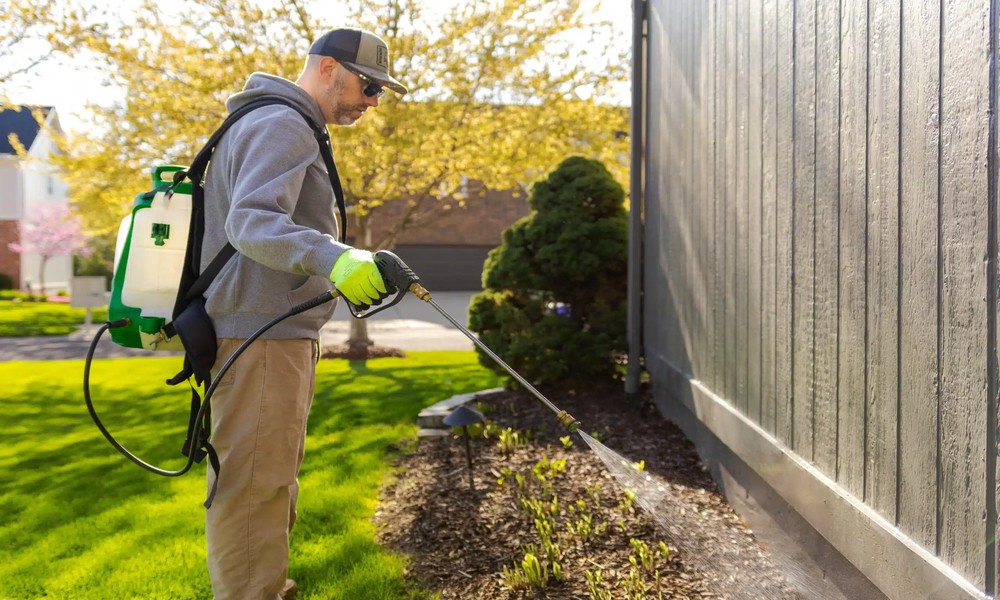
The pesticide question is the one most homeowners ask first. The answer is that no product registered for earthworm control in the United States is approved for jumping worm treatment on residential properties. Some products used in turfgrass management (certain fungicides containing tea seed meal derivatives) produce worm mortality as a side effect, but their labels are specific to turfgrass applications and do not authorize broader property treatment, and their effect on jumping worms is inconsistent across studies.
Attempting to control jumping worms with broadcast pesticide application is both ineffective and illegal under FIFRA (the Federal Insecticide, Fungicide, and Rodenticide Act), which prohibits pesticide use inconsistent with the product label. A pest control company applying a product off-label for jumping worm treatment is risking its license and delivering a treatment that will not solve the problem.
This is the honest answer, and it is one of the few pest situations where a reputable Kansas City pest control provider tells a homeowner there is nothing to sell.
What Actually Slows the Problem
The interventions that work are preventive and cultural rather than chemical. Several are worth genuine attention on any Kansas City property.
Preventing spread is the single highest-leverage intervention. Jumping worms spread primarily through egg cocoons carried in mulch, compost, potted plants, and soil transferred between properties. Buying mulch from a supplier who heat-treats their product to at least 104°F for three consecutive days kills cocoons before distribution. Composting at home should reach and sustain temperatures of 131°F or higher for three days, which is the threshold the University of Wisconsin Extension has documented as sufficient for cocoon mortality.
Inspecting plants before bringing them onto the property matters. Bare-rooting potted plants and rinsing soil off roots before transplanting eliminates one of the most common transmission pathways. Donated divisions from neighbors’ gardens should be treated with the same caution.
Managing yard waste flow. Raking and bagging leaves rather than composting in place in known infested areas disrupts the population’s food supply and limits cocoon production. Leaf litter is the primary feeding substrate for jumping worms, and properties that aggressively remove it show lower population densities over time.
Hand removal on a small scale. Mustard pour (mixing dry yellow mustard powder with water and pouring over suspect soil) brings jumping worms to the surface where they can be collected and disposed of in sealed bags. This is useful for monitoring and for small gardens, but impractical for a full property.
None of these interventions eliminate an established population. They slow the spread, reduce density over time, and prevent the introduction of the worms to uninfested areas of the property.
What This Means for Homeowners Already Infested
The honest message is less satisfying than “we can spray for that,” but more useful. Accepting that jumping worms are now a permanent feature of Kansas City soil, managing mulch and compost sources carefully, inspecting new plant material, and supporting soil health through added organic matter and appropriate plantings produces better long-term outcomes than chasing a chemical solution that does not exist.
Gardeners dealing with heavy infestations can focus on plant selection that tolerates disturbed soil (deep-rooted perennials, native prairie species that have coevolved with soil instability) rather than the fine-rooted ornamentals that jumping worms most severely damage.
The Short Version
Asian jumping worms are now established across Kansas City, they cause real damage to lawn, garden, and woodland soil, and there is no pesticide treatment that legally and effectively controls them. Management is cultural, not chemical. A Kansas City pest control provider such as ZipZap Termite & Pest Control can help identify an infestation and rule out other causes, but the honest answer on treatment is that the work belongs to the homeowner and to the supply chain that delivers mulch and plant material. Any company promising a pesticide solution is selling something that does not work.