
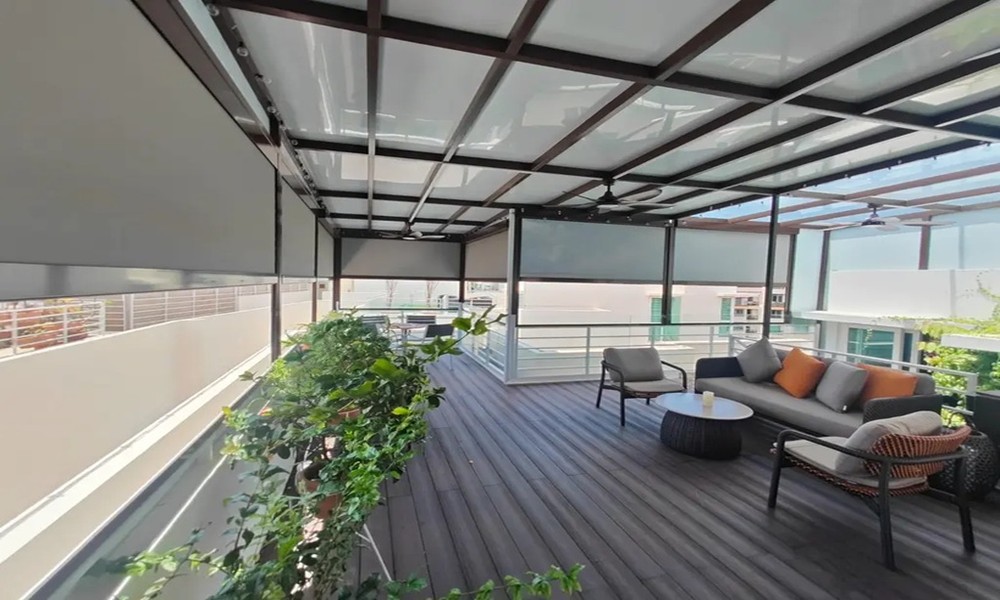

A balcony awning Singapore homeowners install converts one of a flat’s most consistently underutilised spaces into something genuinely liveable. The balcony problem in Singapore is well understood: a west or south-facing balcony in an HDB flat or condominium receives direct afternoon sun at a level that makes it unusable for most of the day, and Singapore’s frequent rain makes leaving outdoor furniture exposed impractical. An awning changes both conditions simultaneously, extending the effective living area of the flat by one usable room.
Why Balconies in Singapore Are So Often Underused
The architecture of Singapore’s high-rise housing was not designed around the assumption that balconies would be used for extended periods in the afternoon heat. A concrete balcony slab facing west with no overhead protection absorbs and re-radiates heat with no mitigation. Surface temperatures on an exposed concrete balcony at three in the afternoon can exceed 50 degrees Celsius. No amount of outdoor furniture or planting compensates for that level of direct solar exposure.
Rain compounds the issue. Singapore’s rainfall arrives suddenly and heavily. A balcony that was pleasantly breezy at two in the afternoon can be completely soaked by three, with puddles that take an hour to dry after the rain stops. Furniture left on an uncovered balcony deteriorates within two to three seasons.
A balcony awning Singapore installation addresses both problems with a single structure. Overhead shading reduces the surface temperature and air temperature of the balcony significantly. A waterproof cover keeps the space dry during rain and allows it to remain usable or to dry quickly after the rain stops.
Types of Balcony Awning Solutions
The choice of balcony awning type depends on the balcony’s size, orientation, structural capacity, the property’s MCST guidelines if applicable, and the homeowner’s preference for fixed versus adjustable coverage.
Fixed aluminium frame with polycarbonate panels is the most robust choice for a balcony that needs reliable weather protection. The rigid structure handles Singapore’s wind conditions well, provides consistent shade regardless of whether anyone is home to operate it, and protects the balcony floor and furniture from rain with no action required. The main limitation is that the balcony is always covered.
A motorised retractable awning provides flexibility: shade and rain protection when extended, open sky when retracted. This works well for balconies where the view or natural light when the weather is pleasant is valued, and where the homeowner is willing to operate the awning on demand. A motorised system with a wind sensor reduces the risk of the awning being caught in a storm when unattended.
Fixed fabric awnings, using weather-resistant acrylic fabric on an aluminium frame, provide shade and some rain protection in a lighter, softer aesthetic than rigid panel systems. They are appropriate for balconies where the visual character of a fabric awning fits the design preference and where the shade is the primary requirement rather than full rain exclusion.
Privacy as a Secondary Benefit
A balcony awning in Singapore’s high-density housing environment provides more than shade. Many balconies in HDB blocks and condominiums are directly overlooked by neighbours across the corridor, by neighbouring flats in facing blocks, or by public walkways. A solid side panel or a roller blind attached to the awning frame creates a visual screen that allows the balcony to be used without the feeling of being observed.
“In Singapore, we have made our high-density living comfortable by thinking carefully about every square metre.” – S Rajaratnam, former Singapore Minister of State.
Side screens for outdoor balcony shade Singapore installations are typically made from outdoor-grade blind fabric, perforated aluminium panels, or louvred boards, depending on the desired privacy level, air circulation and aesthetic preference. Perforated fabric screens allow air movement while obscuring the view from outside. Solid panels eliminate the view entirely but reduce ventilation.
Compliance with HDB and Condominium Requirements
HDB flats have specific guidelines for balcony awning installations. The awning must not project beyond the balcony parapet, must not use materials that affect the external facade in ways that contravene HDB standards, and must comply with any neighbourhood-specific guidelines. Many HDB balcony awning installations fall within the Minor Works category and require submission to HDB for approval before installation.
Condominium balcony modifications require approval from the MCST. Most management corporations maintain a set of design guidelines specifying approved materials, colours and configurations for external modifications. An experienced balcony awning Singapore contractor will be familiar with the approval process and can assist with the submission.
Maximising the Balcony Space
Beyond the awning itself, a covered balcony creates the foundation for a genuinely comfortable outdoor living area. Weather-resistant furniture, outdoor rugs, plants suited to covered semi-outdoor conditions, and lighting for evening use all contribute to a space that competes with the indoor living room as a place to spend time.
The investment in a quality balcony awning Singapore installation typically ranges from S$1,500 to S$5,000 depending on the awning type, balcony size and any side screen additions. The result is a usable outdoor space that adds to the daily quality of life in an apartment where every square metre of usable space has real value.
A balcony awning in Singapore is one of the higher-return home improvement investments available to flat owners, converting dead space into daily-use space at a cost that compares favourably with any interior renovation of equivalent impact.