
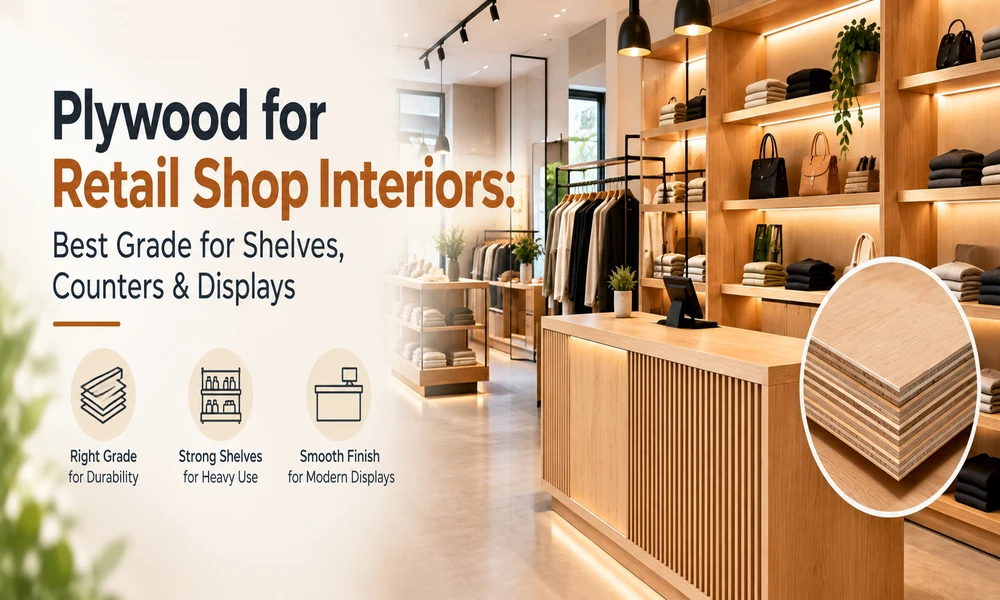

The interior of a retail shop has to deal with a lot of wear and tear. Shelves hold goods during the day, counters are touched by different people, and display units undergo constant cleaning and change. But these features of a retail shop interior also contribute to the impressions the shop creates. So, in order to choose plywood for a retail shop interior, it is necessary to find a compromise between strength, moisture resistance, durability and finishing.
The choice of the correct plywood grade can depend on the use of plywood.
Importance of Plywood Grade for Retail Interiors
Retail furniture needs are different from those in residential applications. Shelves can be loaded with goods all the time, counters can be used with different devices and for storing different things, and display units can be used in a way that the appearance is preserved, but they experience frequent usage.
Three main grades of plywood are taken into account:
BWP plywood: This is meant for cases when moisture exposure is high.
BWR plywood: It provides water resistance under moderate humidity and some wetness.
MR plywood: It serves dry interior purposes and limited moisture exposure.
Thus, the plywood grade must be chosen according to the environment of the shop and the particular unit.
The plywood specification has to consider how much weight the shelf can hold and its size and support placement. In dry retail conditions, MR can be used where there is little contact with moisture. This type of plywood is primarily used indoors and in furniture.
For environments where shelves are subjected to steam cleaning or get wet from time to time, BWR is a plywood that can resist moisture well. The source claims that BWR can be used in moderate humidity conditions.
In case of regular contact with water, BWP plywood is the best.
According to the provided recommendations, 12mm and 16mm plywood can be used in the manufacturing of furniture while 19mm and 25mm can be used in the cases that involve heavier loads.
It should be stated that it is not always reasonable to prefer thicker sheets in all areas of counter production. Countertops, support panels, drawers and back panels may have different specifications depending on the design of furniture.
Plywood for Retail Display Units
Display fixtures have a significant visual function as they present different merchandise to the clients. At the same time, there should be enough construction strength in order to support the load of different merchandise, shelves and display accessories.
According to the source material, displays are also one of the areas where plywood has to withstand load and constant cleaning. Qualitative waterproof plywood should be used for such major commercial purposes.
As for selecting plywood for displays, pay attention to the following points:
Core construction: Passing through the edge of the board, check if the layers are even and there are no visible gaps or voids in the core.
Thickness: Make the thickness match the size of the displays.
Moisture resistance: Choose the thickness according to required washing and environment.
Surface quality: Find the surface which fits the expected laminate, veneer or paint.
Hardware support: Shelves and brackets should be provided with necessary fastening points.
Durability: Pay attention to how often it will be manipulated and what its working conditions will be.
How to Choose Plywood for Retail Shops
To establish what plywood grade would be most appropriate, three practical queries can be answered: what will be the working conditions of a fixture made of plywood, what moisture levels can be expected in the area and how long such a fixture should serve.
For places where dryness predominates, MR plywood can work well, whereas in moderately moist environments BWR performance will be slightly more beneficial. BWP plywood has the highest moisture-resistance level and can be used in conditions where water exposure is high.
Before Using Plywood, One Must Verify
- To obtain ISI certification that the plywood meets the requirements.
- To check the plywood grade assigned to the product.
- Whether gaps between the core and the core construction can be seen.
- Whether the plywood has the same thickness throughout.
- The load characteristics occurring during the operation.
- Whether plywood will undergo any moisture exposure or not.
- Whether it can be used with a specific finish.
- The need for footage prevention of plywood.
Royale Touche offers plywood for different grades, such as Boiling Waterproof Plywood, Moisture Resistant Plywood and plywood concerning marine or other purposes.
When working on a retail project, it would be wise to specify the type of plywood as per the characteristics of the fixture rather than combine one grade for different items.
Conclusion
The optimal type of plywood for retail stores depends on the requirements suggested for such fixtures. Shelves need adequate structural characteristics, counters require strength, and the important features of display units are strength and appearance of the fixture itself.
MR plywood is the most suitable type of plywood for dry retail shops exposed to little moisture. BWR plywood can be recommended for places with mild humidity, while BWP is better usable in situations where high levels of water exposure can be expected.
Thus, by carefully evaluating the thickness and other characteristics of plywood, it is possible to select one that meets the shop’s requirements.